The United Kingdom’s Prime Minister, Keir Starmer, paid his first official visit to India from October 8 to 9, leading the largest-ever delegation of more than 100 CEOs, entrepreneurs, university chancellors, and cultural figures.
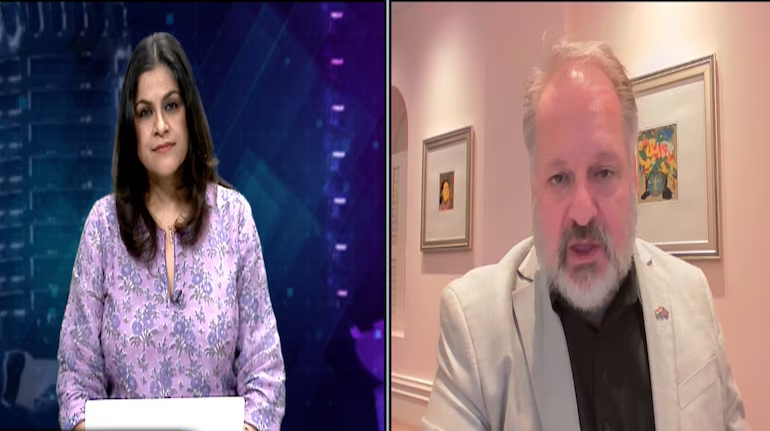
The visit came shortly after India and the UK signed the Comprehensive Economic and Trade Agreement (CETA) in July. To discuss the growing ties between these two major economies, Moneycontrol’s Shweta Punj sat down with Howard Dawber, London’s Deputy Mayor for Business and Growth.
In a candid conversation, Dawber described the FTA as the “deepest deal” ever signed by either India or the UK. He also touched upon issues such as rising anti-immigration sentiment, work visas, and the ease of doing business.
Here are the edited excerpts from the interview:
Shweta Punj: What has been the highlight of your trip so far? I understand you arrived on Monday, October 6, and are staying until Friday or Saturday. Is there anything specific you’re eager to do in Mumbai or Bangalore, and what has stood out most during your visit?
Howard Dawber, London’s Deputy Mayor for Business and Growth, highlighted the enormous potential of the recently signed India-UK Free Trade Agreement (FTA) in a conversation with Moneycontrol’s Shweta Punj.
Global Fintech Fest and business opportunities
Dawber said he was honoured to be one of the opening speakers at the Global Fintech Fest in Mumbai, preceding Prime Ministers Keir Starmer and Narendra Modi. “I’ve met some amazing businesses in Mumbai and Bengaluru who are exploring expanding or moving operations to London. The FTA has created an exciting environment for collaboration between our countries and cities,” he noted.
When asked for specific examples, Dawber mentioned Wipro, which already has 17,000 employees across the UK and Ireland and continues to expand. Smaller companies are also exploring opportunities, but announcements are pending. He emphasised that the FTA is not a superficial trade deal like many signed worldwide; it represents a deep, mutually beneficial platform for collaboration, probably the deepest India or the UK has ever signed.
Incentives for Indian businesses
Dawber chairs London & Partners, an agency supporting businesses to establish and grow in London. “India is currently our top source of foreign direct investment into London, with 77 projects last year. Our goal is to facilitate Indian companies to expand efficiently, helping with local recruitment, funding, grants, and accommodation,” he said. He also highlighted London’s strengths in AI, fintech, quantum computing, health and life sciences, as well as the creative industries, including film and TV production.
Regarding tax incentives, Dawber mentioned R&D tax credits, film production credits, and sector-specific benefits. He also stressed London’s global connectivity, with FTAs with the EU and the USA, and a business-friendly, principles-based regulatory framework that supports innovation.
Safety, law and order, and migration
Addressing concerns over London’s safety, Dawber dismissed exaggerated social media reports of anti-immigration protests, citing London’s diverse and welcoming population. He highlighted effective policing measures and stated that the city is statistically safer than at any time in the past 40 years.
On work visas, Dawber acknowledged the process can be complex but assured Indian businesses that key personnel can be successfully brought to London. “Our system is firm but fair, and we have permanent staff in India to help businesses navigate it,” he said.
Collaboration between Bengaluru and London
Dawber emphasised that services, including tech and IP, are a key focus of the FTA. London’s AI sector alone has 1,500 businesses seeking collaboration with Indian startups. “London should be the first step for Indian companies going global,” he said, adding that Indian businesses setting up in London are treated as local businesses with full legal and IP rights.
Education and research collaborations
Nine UK universities are opening campuses in India, and Dawber highlighted potential two-way collaborations with Indian institutions. He expects growth in AI, deep tech, health and life sciences, sustainability, and the creative industries, particularly film and TV production.
Global context and strategic partnership
On the broader geopolitical stage, Dawber said the UK is strengthening relationships with India as a major trading partner and sees this FTA as a critical platform for collaboration in economics, diplomacy, and defense. “India is emerging as one of the world’s biggest economies, and strong partnerships like this are essential in today’s unpredictable global environment,” he said.
About the Author