AI’s Inflection Point: Echoes of Hardware Disruption
The buzz around artificial intelligence (AI) has reached a fever pitch, but this isn’t just about algorithms or data. We’re standing at a critical juncture in personal hardware, reminiscent of the transformative moments that birthed the personal computer and the modern smartphone.
The tectonic plates of technology are shifting, and today’s established giants—think Intel during the early PC era or Nokia before the iPhone—could struggle to adapt in a world fundamentally reshaped by AI.
Let’s explore the hardware revolution brewing beneath AI’s rise and the existential risks it poses for today’s chipmaking leaders. We’ll also spotlight my Product of the Week: the HP OmniBook X Flip Next Gen AI 16, a device that could make your current laptop feel obsolete.
Tech Revolutions: From PCs to Smartphones
The early personal computing era was fragmented, with no clear standard. Apple changed the game with the Macintosh, democratizing computing and later doing the same with the iPod. Yet even Apple nearly lost its lead in PCs before Steve Jobs’ return and the iPod’s launch.
The smartphone revolution tells a similar story. Surprisingly, IBM created the first smartphone, Simon, in 1994, but failed to capitalize on it. Apple entered late with the iPhone, focusing on the consumer experience and standardizing the market around a touch-centric, app-driven model. This strategy crippled Nokia, Palm, BlackBerry, and sidelined Microsoft’s mobile ambitions, showing that timing alone isn’t enough—execution and vision matter most.
AI Disruption and the Open-Source Surge
AI is poised to trigger a similar upheaval in personal hardware. New players, like AheadComputing—staffed by ex-Intel engineers—are reminiscent of Intel’s scrappy early days.
A major difference this time is the emphasis on open source. AI frameworks, models, and even hardware architectures like RISC-V are being shared freely. This openness challenges Nvidia, the current AI GPU leader, which is less open-source friendly. In contrast, AMD has embraced open standards via ROCm, positioning itself to potentially disrupt Nvidia’s dominance.
If AMD can pivot strategically toward open-source hardware, it could replicate the PC era’s victory of open architectures over proprietary systems—think of it as the ultimate collaborative group project, where everyone contributes.
Are Chip Giants Repeating Tech History?
Yet history rarely repeats exactly. AMD, Intel, and Nvidia may be underestimating the disruptive potential of AI-native hardware and open-source collaboration. Just as PC OEMs dismissed the Macintosh and phone manufacturers underestimated the iPhone, today’s chip giants risk bringing a very fancy abacus to a quantum computing conference if they fail to recognize AI’s transformative impact.
Lessons from History: Microsoft, Danger, and Android
Consider Microsoft’s acquisition of Danger, the maker of the Sidekick—a device that had the potential to be an early iPhone competitor. Instead of nurturing Danger’s innovative, consumer-focused approach, Microsoft integrated it into its enterprise-centric structure, stifling its potential.
Ironically, key members of Danger’s leadership eventually moved to Google, where they helped create Android, a truly open and powerful rival to iOS. This story illustrates how established players can inadvertently pave the way for disruption when they mishandle emerging technologies and talent.
AI-Native Hardware and Open Innovation
Looking ahead, the personal hardware landscape is likely to fragment as AI workloads demand specialized solutions. We can expect:
- Custom processors optimized for neural network inference and training, focusing on energy efficiency and AI framework compatibility.
- Open hardware standards, such as RISC-V, coupled with thriving open-source ecosystems, enabling rapid innovation and broad adoption—much like the IBM PC’s open architecture once did.
The collaboration between OpenAI and Jony Ive’s IO hints at a future of radically new AI-centric devices—interfaces and form factors we have yet to imagine. Your next “computer” could be a sleek, minimalist device that intuitively knows what you need, fundamentally redefining personal computing.
Chipmakers Must Disrupt Themselves
To avoid the fate of Nokia or IBM’s PC division, AMD, Intel, and Nvidia must take the threat of full displacement seriously. Key strategies include:
- Autonomous “skunkworks” divisions: Create labs for radical AI-native hardware and open-source software, free from the constraints of core business operations.
- Embrace open hardware: Actively invest in initiatives like RISC-V, fostering a robust ecosystem beyond proprietary technology.
- Strategic partnerships: Collaborate with AI software leaders and innovative startups, viewing them as partners rather than just customers.
- Explore new computing paradigms: Move beyond traditional CPU/GPU-centric models to anticipate how AI will reshape interactions with technology.
Wrapping Up: Navigating the AI Inflection Point
The AI revolution poses an existential challenge to the semiconductor industry. While AMD, Intel, and Nvidia have talent and resources, their reliance on proprietary models and incremental innovation could become liabilities.
History is filled with leaders who failed to adapt to seismic technological shifts. To avoid becoming cautionary tales, these companies must shed corporate inertia, embrace agile experimentation, and explore unconventional collaborations to create a truly open, AI-native computing future.
The time for incremental change is over. The next chapter demands revolutionary action—otherwise, today’s semiconductor giants risk becoming “that old chip company” in a rapidly evolving landscape.
HP OmniBook X Flip 16-Inch Laptop
The HP OmniBook X Flip 16-inch 2-in-1 AI laptop, along with its 14-inch sibling, is far more than a sleek refresh—it showcases how far laptops have evolved. For those of us who remember the original OmniBook, the contrast is striking. I still recall my CEO handing me one running Windows 95, a system the machine clearly struggled to handle. It wasn’t exactly an impressive introduction to modern computing.
This new OmniBook X Flip, however, is a dramatic leap forward. Sleek, powerful, and AI-ready, it would make any user proud, combining cutting-edge technology with the versatility of a 2-in-1 convertible design.
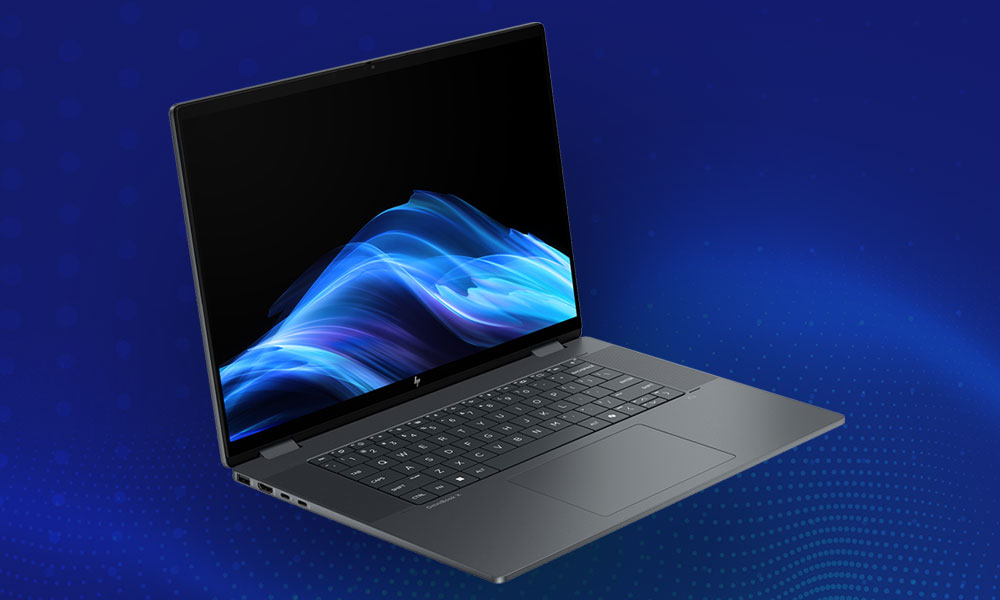
HP OmniBook X Flip 16-Inch: Power, Design, and AI Integration
The star of the show is the Intel Core Ultra 7 processor, part of the Lunar Lake family, paired with Intel Arc graphics. While AMD configurations of the OmniBook X Flip boast higher theoretical TOPS on paper, real-world benchmarks—covering productivity, responsiveness, and media handling—show the Intel version holding its own and often outperforming. This demonstrates Lunar Lake’s architectural efficiency and AI-integrated design, though the verdict may evolve as more nuanced AI benchmarks become available.
Design and 2-in-1 Versatility
True to its name, the X Flip seamlessly transitions into a tablet, feeling like a genuine dual-purpose device, not a laptop pretending to be a tablet. At 4.15 lbs, it is lightweight, balanced, and solid whether you’re typing, sketching, or navigating the touchscreen.
Remote workers will also appreciate Poly audio and camera technology, delivering crisp video and studio-quality microphone pickup—a welcome upgrade for Zoom calls that won’t make you look or sound like a potato.
Display, Colors, and Eco-Friendly Features
The OLED display is stunning, with sharp visuals, rich blacks, and precise color accuracy, perfect for creative work or immersive media consumption. Battery life is strong, easily lasting a full workday and beyond, while connectivity options—including Thunderbolt ports, Wi-Fi 7, and Bluetooth—ensure modern versatility.
Color options include Meteor Silver, Glacier Silver, and Eclipse Gray, with the showstopper Atmospheric Blue available on the 14-inch model. Think of it as wearing a tuxedo with neon socks—professional yet playful.
HP also earns points for sustainability: the chassis uses recycled aluminum, and packaging is largely recyclable, appealing to eco-conscious buyers.
Value and Verdict
Starting at $1,299.99, the OmniBook X Flip offers premium features and AI capabilities at substantial value. With Lunar Lake power, 2-in-1 versatility, and thoughtful design, this laptop is not just a comeback—it’s a confident leap forward.
It is, without question, my Product of the Week.
About the Author